Thursday, September 12, 2013
बिहारी होने का गर्व--
बिहार - जहाँ सबसे पहले महाजनपद बना!
बिहार - जहा बुद्ध को ज्ञान मिला
बिहार - जहाँ के राजा चन्द्रगुप्त मौर्या से लड़ने की हिम्मत सिकंदर को भी नही हुई
बिहार - जहाँ के राजा महान अशोक ने अरब तक हिंदुस्तान का पताका फहराया
बिहार - राजा जराशंध ,पाणिनि(जिसने संश्कृत व्याकरण लिखा ), आर्यभट, चाणक्य(महान अर्थशात्री ),रहीम, कबीर का जन्म हुआ !
बिहार - जहाँ के ८० साल के बूढ़े ने अंग्रेजो के दांत खट्टे कर दिए (बाबु वीर कुंवर सिंह )
बिहार - जिसने देश को पहला राष्ट्रपति दिया
बिहार - जहाँ के गोनू झा के किस्से पुरे हिंदुस्तान में प्रशिद्ध है !
बिहार - जहाँ महान जय प्रकाश नारायण का जन्म हुआ !
बिहार - जहाँ भिखारी ठाकुर (विदेशिया) का जन्म हुआ !
बिहार - जहाँ शारदा सिन्हा जैसी महान भोजपुरी गायिका का जन्म हुआ !
बिहार - जहाँ - स्वामी सहजानंद सरस्वती
राम शरण शर्मा
राज कमल झा
विद्यापति
रामधारी सिंह ‘दिनकर'
रामवृक्ष बेनीपुरी
देवकी नंदन खत्री
इन्द्रदीप सिन्हा
राम करण शर्मा
महामहोपाध्याय पंडित राम अवतार शर्मा
नलिन विलोचन शर्मा
गंगानाथ झा
ताबिश खैर
कलानाथ मिश्र
आचार्य रामलोचन सरन
गोपाल सिंह नेपाली
बिनोद बिहारी वर्मा
आचार्य रामेश्वर झा
राघव शरण शर्मा
नागार्जुन
आचार्य जानकी बल्लभ शाश्त्री
जैसे महान लेखको का जन्म हुआ !
बिहार - जहाँ बिस्स्मिल्लाह खान का जन्म हुआ
बिहार - जहाँ आज भी दिलो में प्रेम बसता है
बिहार - जहाँ आज भी बच्चे अपने माँ - बाप के पैर दबाये बिना नही सोते
बिहार - जहाँ से सबसे ज्यादा बच्चे देश का सबसे कठिन परीक्षा u .p .s .c. और IIT पास करते है
बिहार - जहाँ के गाँव में आज भी दादा दादी अपने बच्चो को कहानिया सुनाते है
बिहार - जहाँ आज भी भूखे रह के अतिथि को खिलाया जाता है
बिहार - जहाँ के बच्चे कोई सुविधा न होते हुए भी देश में सबसे ज्यादा सरकारी नौकरी पते है !
हम इसी बिहार के रहने वाले हैं ! तो कियों न करे खुद के बिहारी होने पर गर्व !जय बिहार !!!


Tuesday, January 29, 2013
I'm proud to be a Bihari, says Mauritius president
Mauritius President Rajkeswur Purryag turned emotional and broke down a number of times while remembering his forefathers who sailed to an alien island some 150 years ago to work in the cane fields there. He arrived here on Sunday along with his wife Aneetah Purryag and a few ministers to associate himself with his roots.
Paying tributes to his great grandfather Lakshman Paryag, who went to Mauritius, and his brother Chawwa, who stayed back here, Purryag said, "Their memory is embedded in my blood. My forefathers went to a distant place but kept Bihar and India alive in their hearts."
Purryag said the relations between India and Mauritius is not that of two nations but that of two brothers. Villagers Mahesh Prasad Nonia and his brother Ganesh are related to the Mauritius president. They touched Purryag's feet and presented him with a silver casket containing the village soil, a branch of paddy and a dhoti.
Speaking in chaste Hindi, the Mauritius president laid stress on education and asked villagers to send their children to school. "If you want to get rid of poverty, you must ensure that your children get proper education." He recalled that when his great grandfather and others went to the island, they worked very hard, lived in huts and ate "basi chawal (stale rice)". Still, they made Mauritius a prosperous nation. He quoted first President of Mauritius Sir Seewoosagur Ramgoolam, who had his roots in Harigaon in Bhojpur district, that education should be the first and last priority.
Purryag had been trying to locate his roots for about 25 years. He said when he came to Bihar some 25 years ago, he tried to find out his roots but failed. Later, when Bihar assembly speaker Uday Narayan Choudhary and after that Bihar CM Nitish Kumar visited Mauritius and met him, he again requested them to locate the place of his ancestors. "I am too happy to place my feet on the land of my ancestors. I will never forget this moment and will come here again," he said.
Praising the leadership of Nitish Kumar, Purryag said, "Ever since he (Nitish) took over the reins of Bihar, the state has been drawing global attention. Bihar is moving on the path of progress. You should remain united, shun casteism and take Bihar to newer heights."
Earlier, he said, he was ashamed of calling himself a Bihari. During his visits to India, he never revealed his Bihar connection. "But today I feel proud to be a Bihari," he said amid cheers.
The CM announced to open a high school in the village in Purryag's name. The village tank would also be named after him since Purryag himself had laid the foundation for its renovation work.
Monday, October 29, 2012
Scientist Aryabhatta
Aryabhata was born in Taregna (literally, song of the stars), which is a small town in Bihar, India, about 30 km (19 mi) from Patna (then known as Pataliputra), the capital city of Bihar State. Evidences justify his birth there. In Taregna Aryabhata set up an Astronomical Observatory in the Sun Temple 6th century.
Aryabhatta studied at the University of Nalanda. One of his major works was Aryabhatiya written in 499 AD. His book aryabhatiya covers astronomical and mathematical theories in which the earth was taken to be spinning on its axis and the periods of the planets were given with respect to the sun. Aryabhatta believes that the moon and planets shine by reflected sunlight and he also believes that the orbits of the planets are ellipses. He correctly explains the causes of eclipses of the Sun and the Moon. His value for the length of the year at 365 days 6 hours 12 minutes 30 seconds is remarkably close to the true value which is about 365 days 6 hours. In this book, the day was reckoned from one sunrise to the next, whereas in his Aryabhata-siddhanta he took the day from one midnight to another. There was also difference in some astronomical parameters.
Aryabhata is the author of several treatises on mathematics and astronomy, some of which are lost. His major work, Aryabhatiya, a compendium of mathematics and astronomy, was extensively referred to in the Indian mathematical literature and has survived to modern times. The mathematical part of the Aryabhatiya covers arithmetic, algebra, plane trigonometry, and spherical trigonometry. It also contains continued fractions, quadratic equations, sums-of-power series, and a table of sines.
Aryabhatta was the first to explain how the Lunar Eclipse and the Solar Eclipse happened. Aryabhatta also gave close approximation for Pi. In the Aryabhatiya, he wrote-“Add 4 to 100, multiply by 8, then add 62000 and then divided by 20000. The result is approximately the circumference of a circle of diameter twenty thousand. By this rule the relation of the circumference to diameter is given.” In other words, p ~ 62832/20000= 3.1416, correct to four rounded – off decimal places. Aryabhatta was the first astronomers to make an attempt at measuring the earth’s circumference. Aryabhata accurately calculated the earth’s circumference as 24835 miles, which was only 0.2 % smaller than the actual value of 24,902 miles. This approximation remained the most accurate for over a thousand years.
Aryabhatiya was translated into Latin in the 13th century. Through this translation, European mathematician got to know methods for calculating the areas of triangles, volumes of spheres as well as square and cube root. Aryabhatta’s ideas about eclipses and the sun being the sources of moonlight may not have caused much of an impression on European astronomers as by then they had come to know of these facts through the observations of Copernicus and Galileo. Considering that Aryabhatta discovered these facts 1500 years ago, and 1000 years before Copernicus and Galileo makes him an early pioneer of this field. Aryabhatta – Siddhanta were reliable for practical purpose of fixing the Panchanga (Hindu Calendar) .


Thursday, May 31, 2012
THE MIRACLE STORY OF BIHAR

Wednesday, May 23, 2012
Bihar's Satyam Kumar cracks IIT entrance test at 12

Reliving the glorious history of Bihar
Monday, May 21, 2012
New Patna world City
Hafeez Contractor, one of India’s best known architects, plans to develop a world city alongside the river Ganges here – on the lines of Dubai – that will boast of eco-friendly buildings and water sports facilities, officials here say.
“Contractor submitted his proposed plans to the state government during his visit here Tuesday,” an official said referring to the proposed New Patna World City.
Chief Minister Nitish Kumar is reportedly impressed by Contractor’s plans to develop a future city in Patna.
 “After Contractor met him in this connection, Kumar has asked development commissioner A.K. Sinha and top officials of the urban development department to have a meeting with Contractor to discuss it,” officials said.
“All the high-rise buildings and apartments will be constructed on eco-friendly lines with water sports facilities on the river side,” the official said.
An official of the urban development department told IANS that Contractor’s plans are to develop a new city spread over an area of 1,700 acres. This would include residential, commercial and entertainment centres on 300 acres while 350 acres would be developed as green fields.
“He plans to develop a park on 600 acres on the lines of the New York park which is spread over 800 acres,” officials said.
Other facilities like seven-star hotels, malls and shopping centres, schools, hospitals, health clubs, meditation centres, art galleries, convention centres and sports centres would be created in the planned city.
Kumar Wednesday laid the foundation for Bihar’s first multi-storeyed industrial complex at the Fatuha industrial area near Patna. At a function on the occasion, he said Contractor had come up with a layout to develop land full of sand near the Ganges.
Contractor said Patna has the potential to become a city like Delhi or Dubai. “Patna has a lot of potential with regard to infrastructure development, especially with the positive leadership in the state,” he said.

Friday, November 4, 2011
KBC 5 winner Sushil Kumar wants to become an IAS officer


Sushil Kumar hails from Motihari, which is about 150 km from Patna. He has been watching KBC for the past 11 years and he says he used to get the right answers most of the time. He got a call on October 17 to participate in the show and the episode featuring him was shot on October 24. But he declines to reveal the last question.
When asked about the winning Rs five crore, Sushil Kumar says that he has been warned by the KBC 5 bosses against revealing the details of the episode. "I have been told not to speak about it till the episode is telecast on November two. I had two lifelines left which I used to attempt the jackpot question, which was linked to my civil services studies,” the PTI quotes him as saying.
Sushil Kumar, who has won Rs 5 crores on Amitabh Bachchan's game show Kaun Banega Crorepati 5 (KBC 5) has revealed that he wants to become an IAS officer. The 27-year-old computer operator from Bihar is busy preparing for my IAS exams. He says that he has planned to utilise his prize money to attend his basic requirements.
Thrilled Sushil Kumar is yet to come to terms. Talking to the PTI, the KBC 5 jackpot winner said, "This is a different kind of feeling. The happiness is difficult to describe in words. I am still to come to terms with the fact that I have made history. It is a beautiful moment. Participation in KBC has been a life changing experience."
Sushil Kumar is an IAS aspirant and besides working as computer operator, he has been busy preparing for civil service exams, which may be held early next year. Talking about his goal of life, he says, "I plan to utilise my prize money to attend to my basic requirements and save rest of the amount. I want to become an IAS officer. I consider myself a student and am busy preparing for my IAS exams which may be held early next year.”
Wednesday, March 23, 2011
राष्ट्रपति ने पलटे बिहार के गौरवशाली अतीत के पन्ने
बिहार विधान परिषद के शताब्दी समारोह में राष्ट्रपति प्रतिभा देवीसिंह पाटील ने बिहार के गौरवशाली अतीत के पन्ने खूब पलटे। उन्होंने प्राचीन बिहार के वैभव और स्वतंत्रता संग्राम में बिहार के योगदान को अपने संबोधन के केंद्र में रखा। इस दौरान उन्होंने महात्मा गांधी के उस वक्तव्य का खासतौर पर जिक्र किया, जिसमें पटना की अपनी प्रार्थना सभा में बापू ने कहा था कि 'यह बिहार ही था जिसने मुझे पूरे भारत में पहचान दी। जब मैं चंपारण पहुंचा तो पूरा देश जाग उठा।'
राष्ट्रपति ने अपने संबोधन का अंत सम्राट अशोक के उस मूलमंत्र से किया। यह वस्तुत: सम्राट की राजाज्ञा थी-'वास्तव में मैं सभी के कल्याण को अपना दायित्व मानता हूं और इसके मूल में है-कठोर परिश्रम तथा कार्य का तुरंत निपटारा। जन कल्याण को बढ़ावा देने से अधिक महान कार्य कोई हो नहीं सकता।'
राष्ट्रपति ने कहा कि बिहार का इतिहास वास्तव में संस्कृति और सभ्यता का इतिहास है। यहां से भारत के दो बड़े साम्राज्यों का उदय हुआ। सबसे पहले सम्राट चंद्रगुप्त मौर्य ने मौर्य साम्राज्य की नींव रखी। इसके बाद चंद्रगुप्त प्रथम के समय गुप्त साम्राज्य की स्थापना हुई। गुप्त युग को भारत का स्वर्ण युग कहा गया है। इस युग में साहित्य, विज्ञान, गणित, धर्म तथा दर्शन ने बहुत तरक्की की। कालीदास, वराहमिहिर, विष्णु शर्मा, वात्स्यायन तथा पुष्पदंत जैसे विद्वान इसी युग में हुए। बिहार में स्थित ऐतिहासिक विक्रमशिला तथा नालंदा विश्वविद्यालय प्राचीन भारत में विश्व के महानतम विश्वविद्यालय थे।
राष्ट्रपति ने कहा कि बिहार की भूमि ने न केवल देश को बल्कि पूरी दुनिया को महान चिंतक, ज्ञानी और दार्शनिक दिए। बिहार की यह धरती, धार्मिक और सांस्कृतिक समन्वय की भी धरती है। इसी प्राचीन भूमि पर महर्षि बाल्मीकि ने रामायण की रचना की थी। जैन धर्म के 24 वें तीर्थकर भगवान महावीर वैशाली में पैदा हुए थे। बौद्ध धर्म के प्रवर्तक भगवान बुद्ध की कार्यस्थली भी बिहार ही थी। पटना में सिखों के 10 वें गुरु गुरु गोविंद सिंह का जन्म हुआ था। इसी तरह बहुत बड़े सूफी संत हजरत मनेरी बिहार से हुए हैं।
स्वतंत्रता संग्राम की चर्चा करते हुए राष्ट्रपति ने सबसे पहले बाबू कुंवर सिंह को याद किया। उन्होंने कहा कि कुंवर सिंह का प्रथम स्वतंत्रता संग्राम में भारी योगदान है। डा.राजेंद्र प्रसाद गांधी जी के साथ आंदोलन में जुड़े थे। हमारे संविधान सभा के अध्यक्ष व स्वतंत्र भारत के पहले राष्ट्रपति बने।
लोकतंत्र की चर्चा करते हुए राष्ट्रपति ने कहा कि लोकतांत्रिक संसदीय व्यवस्था में विधायिका को उसके सदस्यों का बहुत जवाबदेह ढंग से काम करना पड़ता है। बिहार की भूमि पर बहुत पहले लिच्छिवियों ने गणतंत्र का बीज बोया था। जहां लोग शासन में सहभागिता करते हुए समृद्धि और सौहार्द से रहते थे।
Sunday, March 6, 2011
Tathagat Avtar Tulsi becomes IIT Mumbai professor

Dr. Tathagat Avtar Tulsi, a well known young student has made news once again! The 22 Patna boy, Tathagat Avtar Tulsi would be teaching to the students of almost his age at the prestigious Mumbai IIT.
Tathagat Avtar Tulsi would be taking classes in IIT Mumbai from next week onwards. Tathagat Avtar Tulsi would teach the physics in Mumbai IIT as an assistant Physics lecturer.
Tathagat Avtar Tulsi, who is just 22 years old, has completed many prestigious educational degrees including Ph.D.
Dr. Tathagat Avtar Tulsi has completed high school just and nine, and completed BSC by 10, and finished MSC by twelve. He then joined IISC Bangalore and has received the Quantum Computing at 21 years old.
Tathagat Avtar Tulsi is very famous among the educational circles of the country.
Tathagat Avtar Tulsi how now becomes an assistant IIT physic professor from IIT Mumbai and he would be teaching students there from next week.
Tathagat Avtar Tulsi was offered a lecturer post at the prestigious Waterloo University in Canada. Turning down offers from many top colleges around, Tathagat Avtar Tulsi finally decided to go to IIT, Mumbai.
Wednesday, October 13, 2010
Witness - Super 30 Special - 17 July 08 Part 4
शानदार नतीजे देने वाले 'सुपर 30' के संचालक गणितज्ञ आनंद कुमार अब बिहार में आइकान और भारत तथा विदेश में प्रेरक वक्ता के रूप में उभर रहे है। भारत के विभिन्न हिस्सों में प्रेरणादायक व्याख्यान देने के बाद अब वे इंस्टीट्यूट आफ चार्टर्ड एकाउंटेट्स के निमंत्रण पर 14 अक्तूबर को आबूधाबी में व्याख्यान देंगे। इस संस्थान ने उन्हे समग्र शिक्षा पर वार्ता के लिए बुलाया है। इसके पहले संस्थान के निमंत्रण पर पूर्व राष्ट्रपति डा. एपीजे अब्दुल कलाम, केवी कामथ, टीएन मनोहरन और मणि शंकर अय्यर व्याख्यान दे चुके है। अपनी खाड़ी यात्रा के दौरान आनंद कुमार खाड़ी के प्रतिष्ठित स्कूल इंडिया स्कूल आफ आबूधाबी के शिक्षकों और छात्रों के साथ अपना अनुभव बांटेगे।
वे अटलांटा और सैनडिएगो सहित विभिन्न स्थानों पर मैथमेटिकल एसोसिएशन आफ अमेरिका द्वारा आयोजित कुछ कार्यक्रमों में पहले ही व्याख्यान दे चुके है। आईआईएम अहमदाबाद में उनके व्याख्यान की भूरि-भूरि प्रशंसा हुई थी। वे पिज्जा हट और केएफसी के प्रबंधकों के समूहों को भी संबोधित कर चुके है। हाल में न्यूजवीक पत्रिका ने उनके स्कूल को दुनिया के सबसे अनूठे स्कूलों में एक बताया था। एक अन्य प्रतिष्ठित पत्रिका टाइम ने उनके स्कूल को एशिया 2010 का सर्वोत्तम स्कूल बताया था। नंदन नीलकेनी प्रमोद बत्रा और रश्मि बंसल सरीखे मशहूर लेखकों ने उनकी जीवनी और उनके कार्यो को अपनी पुस्तकों में शामिल किया। डिस्कवरी चैनल ने सुपर 30 पर एक घंटे का कार्यक्रम प्रसारित किया। अभिनेत्री और पूर्व मिस जापान नोरिका फुजिवारा सुपर 30 पर एक वृत्तचित्र बनाने के लिए पटना आई। आनंद ने अपनी अद्भुत शिक्षण क्षमता के कारण लिम्का बुक आफ वर्ल्ड रिकार्ड्स में अपना नाम दर्ज कराया। हाल में, अमेरिकी राष्ट्रपति बराक ओबामा के विशेष दूत राशद हुसैन सुपर 30 देखने गए। उन्होंने उसे 'भारत का सर्वोत्तम' शिक्षण संस्थान बताया।
आनंद की प्रतिभा पढ़ाई के शुरुआती दिनों में ही दिखनी शुरू हो गई थी। आनंद को 1994 में कैंब्रिज विवि में उच्चतर शिक्षा का मौका मिला। लेकिन उनकी खराब माली हालत उनके रास्ते में रुकावट बन गई। बचपन से ही गरीबी से जूझने के कारण उन्होंने गरीब छात्रों के लिए कुछ करने का फैसला किया, क्योंकि ऐसे छात्र अवसर के अभाव में मंजिल तक नहीं पहुंच पाते। लिहाजा रामानुजम स्कूल आफ मैथमेटिक्स का जन्म हुआ। 2002 में अपने भाई प्रणव और कुछ छात्रों की मदद से उन्होंने आईआईटी प्रवेश परीक्षा में बैठने के इच्छुक गरीब छात्रों को नि:शुल्क प्रशिक्षण देने के लिए सुपर 30 प्रोग्राम शुरू किया। पिछले तीन सालों में सुपर 30 के सभी 30 छात्र जेईई में सफलता प्राप्त करते आ रहे हैं।
Monday, September 13, 2010
Sunday, September 12, 2010
Sonpur a largest cattle fairs of the world

Sonepur mela – The story
Once upon a time, the king of the jungle – I mean the elephant - was bathing in the river gandhak at Sonepur, when suddenly the king of rivers – I mean crocodile - got his leg, ready to feast on such a meal. A big fight started between the two kings, that lasted 10 days, or then years, or may be ten century. Finally the elephant understood is was going to loose his life, so he prayed to Lord Vishnu for help. The statue at the entrance of Sonepur shows Vishnu coming to save the jungle king.
Sonepur Mela is the one of largest cattle fairs of the world. It is a historical and ancient event celebrated every year on bank of pious confluence of Gandak and the Ganges river, on the back drop of Harihar Nath Temple. On Kartik Purnima lacs of Devotees flock to offer prayer at this temple after taking a holy dip in the river.
The mela has its origins during ancient times. This is when Chandragupta Maurya used to buy elephants and horses across the river Ganges. The Sonepur Cattle Fair once used to attract traders from places as distant as Central Asia.
Nearly all animals can be bought at the Sonepur mela from all breeds of dogs to camels to buffaloes, donkeys, ponies, monkeys, chimps, Persian horses, sheep, rabbits, bears, cats, and guinea pigs. All varieties of birds, poultry and fishes are also available. The area that attracts all, however, is the one where elephants are lined up for sale. The Sonepur Fair is the only one where such a large number of elephants are sold. Numerous stalls are also set up at the grounds of the Sonepur Fair. You will find a wide variety of goods in these stalls, ranging from garments, to weapons and furniture to toys, utensils and agricultural implements to jewelry and handicrafts. Another major attraction is the sight of numerous elephants, beautifully decorated for the purpose of sale.
Originally, the venue of the fair was Hajipur and only the performance of the puja used to take place at the Harihar Nath temple of Sonepur. However, under the rule of the Mughal Emperor Aurangzeb, the venue of the fair got shifted to Sonepur. The temple of Harihar Nath is believed to have been originally built by Lord Rama, on his way to the court of King Janak to win the hand of Mata Sita. It is further said that Raja Man Singh later got the temple repaired. The Harihar Nath temple, as it stands today, was built by Raja Ram Narain, an influential person during the late Mughal period.
Gajendhra Moksha legend is associated with the temple in Sonepur. It involves the story of king Indra Yamuna and the Gandharva chief Huhu, who were turned into an elephant and a crocodile respectively by the curse of great sages Agasthya and Dewala Muni. One day the elephant's leg was bitten by the crocodile. It is said that both of them fought hard for many years with their herds. But ultimately the King Elephant lost his strength and prayed to the Supreme God Vishnu (Hari) to save him. Vishnu heard his prayer and cut down the crocodile with his Chakra. But the touch of the chakra released Huhu from the curse. Vishnu also released Indra Yamuna from his curse and took him to his aboard Vaikuntha.
Sonepur is well connected by road to the nearby City of Chapra, Hajipur, and cities. Sonepur is 25 kilometers from Patna, which is well connected by air, rail and road to the other parts of the country. Sonepur is well connected by Rail links and it is one of main Junction on north eastern railways connecting New Delhi to Guwahati.
The Mela is administered by Chapra District Administrator with due support from Bihar Govt. The promotion of Mela is done by the Tourism Ministry of Bihar. The administration arranges sanitation, drinking water facilities, health and welfare camps for the visitors.
Sonepur Mela gets very wide publicity in media world wide. Foreign news agencies provide good coverage of all the activities.
Siwan is famous for hero of the Mahabharata

Siwan is situated in the western part of North Bihar. It is bordered by Gopalganj District in the north and by the river Ghaghara in the south beyond which lies the Ballia district of Uttar Pradesh. In the east of Siwan lies Saran District while Deoria District bounds it from the west. The global location of Siwan District is between 25° 53' to 26° 23' North latitudes and 84° 1' to 84° 47' East longitudes. Siwan covers an area of 2219 sq. km. Siwan, the district headquarters, is located on the eastern bank of river Daha. According to the 2001 census the population of the Siwan District is 27, 14,349. Siwan has an average literacy rate of 83%, higher than the national average of 59.5%: male literacy is 69%, and female literacy is 55%.
Siwan derived its name from "Shiva Man", a Bandh Raja who ruled this area once upon a time and his successors reigned till Babar's advent.
The district forms a part of the alluvium of the broader Indo-Gangetic Plain. The district is navigated by few small rivers like Jharahi, Daha, Gandaki, Dhamati or Dhamahi, Siahi, Nikari and Sona. Along with the smaller ones Ghaghara is the perennial river which flows alongside the district's boundary. This region is marked by some typical geographical formations like 'Chaurs' and 'Draras'.
At present there are sixteen functional blocks in the district namely - Siwan, Mairwa, Darauli, Guthani, Hussainganj, Andar, Raghunathpur, Siswan, Barharia, Pachrukhi under Siwan subdivision and Maharajganj, Duraondha, Goreakothi, Basantpur, Bhagwanpur and Lakri Nabiganj under Maharajganj subdivision.
The place of the stalwart and robust 'Bhoj-puries', Siwan District is important as a tourist spot. Some believe Siwan to be the place where Lord Buddha died. Also known as Aliganj Sawan after the name of Ali Bux; Siwan has historical and mythological importance attached to it.
Dr. Rajendra Prasad was the first President of India.He was born in Zeradei, in the Siwan district.
Khuda Baksh was born in village Ukhai, 6 k.m. from Siwan district on 2nd August 1842 in his parental house. The ancestors of Khuda Baksha were in service of King Alamgir. They were doing the work of book keeping and writing records of the kingdom.
Maulana Mazharul Haque was born on 22 Dec. 1866 in village Brahmpur, Thana Maner of Patna district. He got lot of land donated to him by his relatives and settled in village Faridpur of district Siwan in 1900.
Historical Places
Amarpur : Amarpur is a village situated 3 Kms. West of Darauli. In this village ruins of mosque of red bricks on the bank of river Ghaghara are still available. This mosque was build during the reign of Mughal Emperor Shahjahan (1626-1658) under the supervision of the Naib Amar Singh but the work was left incomplete. The village derived its name from the builder of the mosque Amar Singh.
Faridpur : Faridpur situated just near Andar is the birthplace of Maulana Mazharul Haque who played an important role during the freedom movement. Sadaquat Ashram in Patna, originally belonged to him. He was a symbol of Hindu Muslim unity.
Darauli : A block headquarter now is said to be have been founded after the name of Dara Shikoh, the elder son of the Emperor Shahjahan. It's name was Daras Ali, which later on was changed into Darauli. There is reminiscence of Mughal period ruins where a big mela is held every year on the Kartik Purnima.
Don : A village in the Darauli block where there are remnants of a fort, which is said to be connected with the famous hero of the Mahabharat, Acharya Dronacharya the guru of both Kaurav’s and Pandav’s. Brahmin Dona built his stupa here.
Dona's stupa is a lesser-known but popular Buddhist pilgrimage site, despite its isolated location. The Buddhis traveller Hiuen Tsang mentions a visit to Don in his account of his travels in India. He describes the stupa as being in ruins. The account of Dona's distribution of Buddha's ashes and being given the vessel is a mentioned in the end of the Mahaparinibbana Sutta, which is described in Maurice Walsh's The Long Discourses. Presently Dona's stupa is a grassy hill and has a Hindu temple built over it, where a beautiful statue of Tara is worshipped as a Hindu goddess. This statue was carved in the 9th century. Tourists on a Buddhist Pilgrimage Tour are sure to appreciate the historic sight of the stupa at Don.
Don can be reached from Patna to Siwan via Chhapra. A day trip from Kusinagar via Gopalganj can also be arranged.
Hasanpura : It is a village in the Hussainganj block. It is said that Makhdum Sayyad Hasan Chisti, a saint who came from Arabia to India and settled here, found it. He founded a Khankhah too.
Lakri Dargah : It is the place of pilgrimage for the Mohammedans. The village is so called because it contains the tomb(Dargah) of a Mohammedan saint, Shah Arjan of Patria, in which there is some good woodwork. The story runs that the saint, attracted by the solitude of the place, performed a Chila here, i.e., gave himself up to religious contemplation for 40 days. He also set up a religious establishment, which was endowed by the Emperor Aurangzeb. The anniversary of the saint's death is celebrated the 11th of Rabi-us-sani every year which attracts a large crowd.
Maharajganj : A block headquarters now, it was also called Basnauli Gangar. It is the largest bazar in the district. This was the place where great hero of Indian Independence Movement, Shri Phulena Prasad centralised his activity and fought against the Britishers.
Mairwa Dham : A block headquarters now, there is a celebrated Brahma Asthan, locally known as Hari Baba ka Asthan, the shrine having been built over the relics of the saint. There is also a mound called Chananriyam Dih from an Ahirni woman who is now worshipped in a shed built in front of the Dak bungalow which occupies the top of the mound. The shrine is on the bank of the Jharhi River and fairs are held in Kartik and Chaitra months. There is also a leper home at Mairwa known as Kustha Sevasram whcih is doing useful work.
Mehandar : A village in Siswan Blcok, where there is a temple of Lord Shiva & Lord Vishwakarma which is visited by the people of the locality on the Shivaratri day & Vishwakarma Puja (17 Sept) Day. It is known for its temple and a pond scatted over an area of more than 52 bighas. It is said that one Nepal king built these and took his bath in the pond and got his leprosy cured.
Ziradei : It is a village in the Hussainganj Blcok. Dr.Rajendra Prasad, the first President of the Indian Republic, belonged to this village.
Bhikhabandh : A village in Maharajganj Block, there is a big tree under the shade of which Bhaiya-Bahini temple is situated. The story runs that these brother and sister fought Mughal sepoys in the 14th century and died here in course of fighting.
Harpur : It is a village in the Pachrukhi block.This village is known by Mr. Gorakh Nath Prasad who established unity in this village by educating the people.
Colleges:
1.DAV College (under J.P. University), 2.Z A Islamia College 3.Daroga Rai College 4.VidyaBahwan(for women) Medical Colleges 5.Unani Medical College and Hospital 6. Dayanand Ayurvedic Medical College 7.Siwan Homeopathic Medical College Engineering College 8.Siwan Engineering and Technology Institute & many more.
Jagdev Prasad a fearless leader

Jagdev Prasad (1922-1974) was a fearless leader from Bihar who fought for the cause of the backward and downtrodden sections of the society. Hailing from a humble background, the young Jagdev had to undergo many hardships to pursue his studies.
He secured a Master's Degree in Economics from the Patna University in 1950. He joined the Socialist Party and contributed his mite to fight social inequalities and economic exploitation, which continued to stain the social fabric of India, despite the attainment of freedom.
In 1967, he contested for the 4th Bihar Assembly from Kurtha and emerged victorious. He played an important role in forming the first ever coalition government in Bihar with Mahamaya Prasad Singh as the Chief Minister.
He left the Government and the Party in anguish and formed his own 'Shosit Dal'. Jagdev Prasad was also noted for his suave penmanship. His journalistic career started in 1953 with 'Janata', the organ of the Socialist Party. Later, he also edited the English weekly, 'Citizen' and the Hindi weekly, 'Uday'.
The life and political career of Jagdev Prasad had an unfortunate end in 1974, when he received a bullet shot in his neck in the confusion which arose out of the police firing at a rally in Kurtha, which he was addressing.
Samrat Ashoka the great


King Asoka, the third monarch of the Indian Mauryan (Kushwaha) dynasty from Patliputra (Patna), has come to be regarded as one of the most exemplary rulers in world history. The British historian H.G. Wells has written: "Amidst the tens of thousands of names of monarchs that crowd the columns of history ... the name of Asoka shines, and shines almost alone, a star." Although Buddhist literature preserved the legend of this ruler -- the story of a cruel and ruthless king who converted to Buddhism and thereafter established a reign of virtue -- definitive historical records of his reign were lacking. Then in the nineteenth century there came to light a large number of edicts, in India, Nepal, Pakistan and Afghanistan. These edicts, inscribed on rocks and pillars, proclaim Asoka's reforms and policies and promulgate his advice to his subjects. The present rendering of these edicts, based on earlier translations, offers us insights into a powerful and capable ruler's attempt to establish an empire on the foundation of righteousness, a reign which makes the moral and spiritual welfare of his subjects its primary concern. The Australian bhikkhu Ven. S. Dhammika, the compiler of the present work, is the spiritual director of the Buddha Dhamma Mandala Society in Singapore.
With the rediscovery and translation of Indian literature by European scholars in the 19th century, it was not just the religion and philosophy of Buddhism that came to light, but also its many legendary histories and biographies. Amongst this class of literature, one name that came to be noticed was that of Asoka, a good king who was supposed to have ruled India in the distant past. Stories about this king, similar in outline but differing greatly in details, were found in the Divyavadana, the Asokavadana, the Mahavamsa and several other works. They told of an exceptionally cruel and ruthless prince who had many of his brothers killed in order to seize the throne, who was dramatically converted to Buddhism and who ruled wisely and justly for the rest of his life. None of these stories were taken seriously -- after all many pre-modern cultures had legends about "too good to be true" kings who had ruled righteously in the past and who, people hoped, would rule again soon. Most of these legends had their origins more in popular longing to be rid of the despotic and uncaring kings than in any historical fact. And the numerous stories about Asoka were assumed to be the same.
But in 1837, James Prinsep succeeded in deciphering an ancient inscription on a large stone pillar in Delhi. Several other pillars and rocks with similar inscriptions had been known for some time and had attracted the curiosity of scholars. Prinsep's inscription proved to be a series of edicts issued by a king calling himself "Beloved-of-the-Gods, King Piyadasi." In the following decades, more and more edicts by this same king were discovered and with increasingly accurate decipherment of their language, a more complete picture of this man and his deeds began to emerge. Gradually, it dawned on scholars that the King Piyadasi of the edicts might be the King Asoka so often praised in Buddhist legends. However, it was not until 1915, when another edict actually mentioning the name Asoka was discovered, that the identification was confirmed. Having been forgotten for nearly 700 years, one of the greatest men in history became known to the world once again.
Asoka's edicts are mainly concerned with the reforms he instituted and the moral principles he recommended in his attempt to create a just and humane society. As such, they give us little information about his life, the details of which have to be culled from other sources. Although the exact dates of Asoka's life are a matter of dispute among scholars, he was born in about 304 B.C. and became the third king of the Mauryan dynasty after the death of his father, Bindusara. His given name was Asoka but he assumed the title Devanampiya Piyadasi which means "Beloved-of-the-Gods, He Who Looks On With Affection." There seems to have been a two-year war of succession during which at least one of Asoka's brothers was killed. In 262 B.C., eight years after his coronation, Asoka's armies attacked and conquered Kalinga, a country that roughly corresponds to the modern state of Orissa. The loss of life caused by battle, reprisals, deportations and the turmoil that always exists in the aftermath of war so horrified Asoka that it brought about a complete change in his personality. It seems that Asoka had been calling himself a Buddhist for at least two years prior to the Kalinga war, but his commitment to Buddhism was only lukewarm and perhaps had a political motive behind it. But after the war Asoka dedicated the rest of his life trying to apply Buddhist principles to the administration of his vast empire. He had a crucial part to play in helping Buddhism to spread both throughout India and abroad, and probably built the first major Buddhist monuments. Asoka died in 232 B.C. in the thirty-eighth year of his reign.
Asoka's edicts are to be found scattered in more than thirty places throughout India, Nepal, Pakistan and Afghanistan. Most of them are written in Brahmi script from which all Indian scripts and many of those used in Southeast Asia later developed. The language used in the edicts found in the eastern part of the sub-continent is a type of Magadhi, probably the official language of Asoka's court. The language used in the edicts found in the western part of India is closer to Sanskrit although one bilingual edict in Afghanistan is written in Aramaic and Greek. Asoka's edicts, which comprise the earliest decipherable corpus of written documents from India, have survived throughout the centuries because they are written on rocks and stone pillars. These pillars in particular are testimony to the technological and artistic genius of ancient Indian civilization. Originally, there must have been many of them, although only ten with inscriptions still survive. Averaging between forty and fifty feet in height, and weighing up to fifty tons each, all the pillars were quarried at Chunar, just south of Varanasi and dragged, sometimes hundreds of miles, to where they were erected. Each pillar was originally capped by a capital, sometimes a roaring lion, a noble bull or a spirited horse, and the few capitals that survive are widely recognized as masterpieces of Indian art. Both the pillars and the capitals exhibit a remarkable mirror-like polish that has survived despite centuries of exposure to the elements. The location of the rock edicts is governed by the availability of suitable rocks, but the edicts on pillars are all to be found in very specific places. Some, like the Lumbini pillar, mark the Buddha's birthplace, while its inscriptions commemorate Asoka's pilgrimage to that place. Others are to be found in or near important population centres so that their edicts could be read by as many people as possible.
There is little doubt that Asoka's edicts were written in his own words rather than in the stylistic language in which royal edicts or proclamations in the ancient world were usually written in. Their distinctly personal tone gives us a unique glimpse into the personality of this complex and remarkable man. Asoka's style tends to be somewhat repetitious and plodding as if explaining something to one who has difficulty in understanding. Asoka frequently refers to the good works he has done, although not in a boastful way, but more, it seems, to convince the reader of his sincerity. In fact, an anxiousness to be thought of as a sincere person and a good administrator is present in nearly every edict. Asoka tells his subjects that he looked upon them as his children, that their welfare is his main concern; he apologizes for the Kalinga war and reassures the people beyond the borders of his empire that he has no expansionist intentions towards them. Mixed with this sincerity, there is a definite puritanical streak in Asoka's character suggested by his disapproval of festivals and of religious rituals many of which while being of little value were nonetheless harmless.
It is also very clear that Buddhism was the most influential force in Asoka's life and that he hoped his subjects likewise would adopt his religion. He went on pilgrimages to Lumbini and Bodh Gaya, sent teaching monks to various regions in India and beyond its borders, and he was familiar enough with the sacred texts to recommend some of them to the monastic community. It is also very clear that Asoka saw the reforms he instituted as being a part of his duties as a Buddhist. But, while he was an enthusiastic Buddhist, he was not partisan towards his own religion or intolerant of other religions. He seems to have genuinely hoped to be able to encourage everyone to practice his or her own religion with the same conviction that he practiced his.
Scholars have suggested that because the edicts say nothing about the philosophical aspects of Buddhism, Asoka had a simplistic and naive understanding of the Dhamma. This view does not take into account the fact that the purpose of the edicts was not to expound the truths of Buddhism, but to inform the people of Asoka's reforms and to encourage them to be more generous, kind and moral. This being the case, there was no reason for Asoka to discuss Buddhist philosophy. Asoka emerges from his edicts as an able administrator, an intelligent human being and as a devoted Buddhist, and we could expect him to take as keen an interest in Buddhist philosophy as he did in Buddhist practice.
The contents of Asoka's edicts make it clear that all the legends about his wise and humane rule are more than justified and qualify him to be ranked as one of the greatest rulers. In his edicts, he spoke of what might be called state morality, and private or individual morality. The first was what he based his administration upon and what he hoped would lead to a more just, more spiritually inclined society, while the second was what he recommended and encouraged individuals to practice. Both these types of morality were imbued with the Buddhist values of compassion, moderation, tolerance and respect for all life. The Asokan state gave up the predatory foreign policy that had characterized the Mauryan empire up till then and replaced it with a policy of peaceful co-existence. The judicial system was reformed in order to make it more fair, less harsh and less open to abuse, while those sentenced to death were given a stay of execution to prepare appeals and regular amnesties were given to prisoners. State resources were used for useful public works like the importation and cultivation of medical herbs, the building of rest houses, the digging of wells at regular intervals along main roads and the planting of fruit and shade trees. To ensue that these reforms and projects were carried out, Asoka made himself more accessible to his subjects by going on frequent inspection tours and he expected his district officers to follow his example. To the same end, he gave orders that important state business or petitions were never to be kept from him no matter what he was doing at the time. The state had a responsibility not just to protect and promote the welfare of its people but also its wildlife. Hunting certain species of wild animals was banned, forest and wildlife reserves were established and cruelty to domestic and wild animals was prohibited. The protection of all religions, their promotion and the fostering of harmony between them, was also seen as one of the duties of the state. It even seems that something like a Department of Religious Affairs was established with officers called Dhamma Mahamatras whose job it was to look after the affairs of various religious bodies and to encourage the practice of religion.
The individual morality that Asoka hoped to foster included respect (//susrusa//) towards parents, elders, teachers, friends, servants, ascetics and brahmins -- behavior that accords with the advice given to Sigala by the Buddha (Digha Nikaya, Discourse No. 31). He encouraged generosity (//dana//) to the poor (//kapana valaka//), to ascetics and brahmins, and to friends and relatives. Not surprisingly, Asoka encouraged harmlessness towards all life (//avihisa bhutanam//). In conformity with the Buddha's advice in the Anguttara Nikaya, II:282, he also considered moderation in spending and moderation in saving to be good (//apa vyayata apa bhadata//). Treating people properly (//samya pratipati//), he suggested, was much more important than performing ceremonies that were supposed to bring good luck. Because it helped promote tolerance and mutual respect, Asoka desired that people should be well-learned (//bahu sruta//) in the good doctrines (//kalanagama//) of other people's religions. The qualities of heart that are recommended by Asoka in the edicts indicate his deep spirituality. They include kindness (//daya//), self-examination (//palikhaya//), truthfulness (//sace//), gratitude (//katamnata//), purity of heart (//bhava sudhi//), enthusiasm (//usahena//), strong loyalty (//dadha bhatita//), self-control (//sayame//) and love of the Dhamma (//Dhamma kamata//).
We have no way of knowing how effective Asoka's reforms were or how long they lasted but we do know that monarchs throughout the ancient Buddhist world were encouraged to look to his style of government as an ideal to be followed. King Asoka has to be credited with the first attempt to develop a Buddhist polity. Today, with widespread disillusionment in prevailing ideologies and the search for a political philosophy that goes beyond greed (capitalism), hatred (communism) and delusion (dictatorships led by "infallible" leaders), Asoka's edicts may make a meaningful contribution to the development of a more spiritually based political system.
Gol Ghar in Patna

After the devastating famine of 1770, which killed nearly 10 million people in regions of Bengal, Bihar and modern day Bangladesh, Warren Hastings, then Governor-General of India, ordered the construction of this beehive shaped structure for the purpose of storing grains for the British Army [2]. It was conceived and built by Captain John Garstin, an engineer with the East India Company [3], and has a storage capacity of 140000 tons, it construction was completed on 20 July 1786.
Built in the native Stupa architecture, the building has a foundation of 125m, and a height of 29 m. It is pillarless with a wall of thickness of 3.6 m at the base. One can climb atop the Golghar through the 145 steps of its spiral stairway around the monument. The spiral staircase was designed so as to facilitate the passage of the coolies, who had to carry grain-bags up one flight, deliver their load through a hole at the top, and descend the other stairs.
The top of the Golghar presents a wonderful panoramic view of the city and the Ganga flowing nearby. At time of its construction, it was the tallest building in Patna.
One interesting fact about the Golghar is that never in its existence has it been filled to its maximum capacity and there are no plans in future as well. The reason for this is that due to oversight while designing and construction of the Golghar, the doors were designed to open inside. Thus, if it is filled to its maximum capacity, then the doors will not open.
Seven Martyr's sacrificed lives in the Quit India movement

The Martyr's Memorial is a life-size statue of seven brave young men who sacrificed their lives in the Quit India movement(August 1942), to hoist the national flag on the (now) Secretariat building.Britisher's kept firing on them until they died. The foundation stone of Martyr's Memorial was laid on August 15, 1947, by the governor of Bihar, Mr. Jairam Das Daulatram. The sculptor Mr. Deviprasad Roychoudhry built the bronze statue of the seven students with the national flag. These statues were cast in Italy and later placed here.
Following are the martyrs, whose names are engraved on Martyr's Memorial.
* Umakant Prasad Sinha - Ram Mohan Roy Seminary,class IX
* Ramanand Singh - Ram Mohan Roy Seminary, class IX
* Satish Prasad Jha - Patna Collegiate School, class X
* Jagatpati Kumar - Bihar National College, 2nd year
* Devipada Choudhry - Miller High English School, class IX
* Rajendra Singh - Patna High English School, matric class
* Ramgovind Singh - Punpun High English School, matric class IX
Saturday, September 11, 2010
First President of India from Siwan
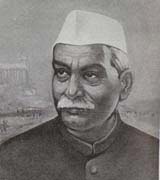
Dr. Rajendra Prasad
January. 26, 1950 to May 13, 1962
Dr. Rajendra Prasad,son of Mahadev Sahai, was born in (Siwan) Zeradei, Bihar on December 3, 1884. Being the youngest in a large joint family "Rajen" was greatly loved. He was strongly attached to his mother and elder brother Mahendra. In Zeradei's diverse population, people lived together in considerable harmony. Rajendra Prasad's earliest memories were of playing "kabaddi" with his Hindu and Muslim friends alike. In keeping with the old customs of his village and family, Rajen was married when he was barely 12 years old to Rajvanshi Devi.
Rajen was a brilliant student; standing first in the entrance examination to the University of Calcutta, he was awarded a Rs.30/month scholarship. He joined the famed Calcutta Presidency College in 1902. His scholarship, ironically, would pose the first test of his patriotism. Gopal Krishna Gokhale had started the Servants of India Society in 1905 and asked Rajen to join. So strong was his sense of duty toward his family and education that he, after much deliberation, refused Gokhale. But the decision would not rest easy on him. Rajen recalled, "I was miserable" and for the first time in his life his performance in academia declined, and he barely cleared his law examinations.
Having made his choice, however, he set aside the intruding thoughts, and focused on his studies with renewed vigor. In 1915, Rajen passed the Masters in Law examination with honors, winning a gold medal. Subsequently, he completed his Doctorate in Law as well.
As an accomplished lawyer, however, Rajen realized it would be only a matter of time before he would be caught up in the turmoil of the fight for independence. While Gandhiji was on a fact finding mission in Chamaparan district of Bihar to address grievances of local peasants, he called on Rajendra Prasad to come to Champaran with volunteers. Dr. Prasad rushed to Champaran. Initially he was not impressed with Gandhiji's appearance or conversation. In time, however, Dr. Prasad was deeply moved by the dedication, conviction and courage that Gandhiji displayed. Here was a man alien of the parts, who had made the cause of the people of Champaran his own. Dr.Prasad decided that he would do everything he could to help, with his skills as a lawyer and as an enthusiastic volunteer.
Gandhiji's influence greatly altered many of Dr. Prasad's views, most importantly on caste and untouchability. Gandhiji made Dr. Prasad realize that the nation, working for a common cause, "became of one caste, namely co-workers." Dr. Prasad reduced the number of servants he had to one, and sought ways to simplify his life. He no longer felt shame in sweeping the floor, or washing his own utensils, tasks he had all along assumed others would do for him.
Whenever the people suffered, Dr. Prasad was present to help reduce the pain. In 1914 floods ravaged Bihar and Bengal. Dr. Prasad became a volunteer distributing food and cloth to the flood victims. In 1934, Bihar was shaken by an earthquake, which caused immense damage and loss of property. The quake, devastating by itself, was followed by floods and an outbreak of malaria which heightened misery. Dr. Prasad dove right in with relief work, collecting food, clothes and medicine. His experiences here led to similar efforts elsewhere too. In 1935, an earthquake hit Quetta. Dr. Prasad was not allowed to lend a hand because of Government restrictions. Nevertheless, he set up relief committees in Sind and Punjab for the homeless victims who flocked there.
Dr. Prasad called for non-cooperation in Bihar as part of Gandhiji's non-cooperation movement. Dr. Prasad gave up his law practice and started a National College near Patna, 1921. The college was later shifted to Sadaqat Ashram on the banks of the Ganga. The non-cooperation movement in Bihar spread like wildfire. Dr. Prasad toured the state, holding public meeting after another, collecting funds and galvanizing the nation for a complete boycott of all schools, colleges and Government offices. He urged the people to take to spinning and wear only khadi. Bihar and the entire nation was taken by storm, the people responded to the leaders' call. The machinery of the mighty British Raj was coming to a grinding... halt.
The British India Government utilized the one and only option at its disposal-force. Mass arrests were made. Lala Lajpat Rai, Jawaharlal Nehru, Deshbandhu Chittranjan Das and Maulana Azad were arrested. Then it happened. Peaceful non- cooperation turned to violence in Chauri Chaura, Uttar Pradesh. In light of the events at Chauri Chaura, Gandhiji suspended the civil disobedience movement. The entire nation was hushed. A murmur of dissent began within the top brass of the Congress. Gandhiji was criticized for what was called the "Bardoli retreat."
Dr. Prasad stood by his mentor, seeing the wisdom behind Gandhiji's actions. Gandhiji did not want to set a precedent of violence for free India. In March 1930, Gandhiji launched the Salt Satyagraha. He planned to march from Sabarmati Ashram to Dandi seashore to break the salt laws. A salt satyagraha was launched in Bihar under Dr. Prasad. Nakhas Pond in Patna was chosen as the site of the satyagraha. Batch after batch of volunteers courted arrest while making salt. Many volunteers were injured. Dr. Prasad called for more volunteers. Public opinion forced the Government to withdraw the police and allow the volunteers to make salt. Dr. Prasad then sold the manufactured salt to raise funds. He was sentenced to six months imprisonment.
His service on the various fronts of the movement for independence raised his profile considerably. Dr. Prasad presided over the Bombay session of the Indian National Congress in October 1934. Following the resignation of Subhash Chandra Bose as the President of the Congress in April 1939, Dr. Prasad was elected President. He did his best to heal the rifts created between the incompatible ideologies of Subhash Chandra Bose and Gandhiji. Rabindranath Tagore wrote to Dr. Prasad, "I feel assured in my mind that your personality will help to soothe the injured souls and bring peace and unity into an atmosphere of mistrust and chaos..."
As the freedom struggle progressed, the dark shadow of communalism which had always lurked in the background, steadily grew. To Dr. Prasad's dismay communal riots began spontaneously burst all over the nation and in Bihar. He rushed from one scene to another to control the riots. Independence was fast approaching and so was the prospect of partition. Dr. Prasad, who had such fond memories of playing with his Hindu and Muslim friends in Zeradei, now had the misfortune of witnessing the nation being ripped into two.
In July 1946, when the Constituent Assembly was established to frame the Constitution of India, Dr. Rajendra Prasad was elected its President. Two and a half years after independence, on January 26, 1950, the Constitution of independent India was ratified and Dr. Rajendra Prasad was elected the nation's first President. Dr. Prasad transformed the imperial splendor of Rashtrapati Bhavan into an elegant "Indian" home. Dr. Prasad visited many countries on missions of goodwill, as the new state sought to establish and nourish new relationships. He stressed the need for peace in a nuclear age.
In 1962, after 12 years as President, Dr. Prasad retired, and was subsequently awarded the Bharat Ratna, the nation's highest civilian award. With the many tumults of his vigorous and accomplished life, Dr. Prasad recorded his life and the decades before independence in many books, among the more noted of which are "Satyagraha at Champaran" (1922), "India Divided" (1946), his autobiography "Atmakatha" (1946), "Mahatma Gandhi and Bihar, Some Reminisences" (1949), and "Bapu ke Kadmon Mein" (1954).
Dr. Prasad spent the last few months of his life in retirement at the Sadaqat Ashram in Patna. He died on February 28, 1963. In her first citizen, India had imagined a life of possibilities, and seen an unsurpassed dedication to making them real.
World Largest Ancient Nalanda University

About Nalanda University
Considered as the city of monks, Nalanda is a big draw for all Buddhist pilgrims from around the world. Huen Tsang studied in the Nalanda University in mid 600's. It was one of the biggest and oldest universities of the world and was considered as an epicenter of civilization during that period of time. Located in the state of Bihar, Presently a small town, Nalanda is a historic city with various ancient relics dotting its topography. The excavated piece of ancient Indian culture housed in the Nalanda university archaeological complex is always a sample of interest to historians. Nalanda is associated with various religions and religious gurus. The small town was also visited by Lord Buddha (Father of Buddhism), Lord Mahavir (Father of Jainism), Emperor Harshavardhan, The Ashoka (Two great Hindu Kings), all of whom contributed a lot to this pristine land.
Nalanda is a village of archaeological importance and the signs of ancient Buddhist culture are visible in it. Many monuments relating to the birth and spread of Buddhism could be seen here. The village has an antique touch of religion and wisdom going hand in hand. The altitude of Nalanda is of 67 meters and ruins of once greatest university of learning is scattered all around the village. A large number of ancient Buddhist establishment -Stupas, Chaityas, Temples and Monastery sites are common in Nalanda. The Nalanda museum has many of the ancient antique pieces preserved delicately.
Nalanda University Archaeological Complex- Nalanda University Archaeological Complex is an architectural heritage. It is spread across 14 hectares of land, the building is beautifully built by red bricks and the glorious garden in front of the university further adds more charm. There are beautiful monasteries and also chaityas(temples) adorned the university.
The Nalanda Archaeological Museum - One of the prime attractions of Nalanda, its the signature site of the tourist. The museum preserve rare artifacts of Buddhist era and also Hindu statues and artifacts. The fine lord Buddha statues are also one of the attraction.
Nava Nalanda Mahavihara- This education institute constructed in 1951 was dedicated to the research and study of Buddhism and Pali literature. It is now a popular tourist attraction.
Hieun Tsang Memorial Hall – The hall was made in the memorial of famous Chinese traveler Hieun Tsang. Here you can find some ancient manuscripts, relics and snaps of trail of Hien Tsang.
Surajpur Baragaon – Surajpur Baragaon is a revered Hindu pilgrimage located close to Nalanda and also visited by many people. The main attraction of the temple is huge sun temple beside the lake.
Not To Overlook- Excursions From Nalanda
Rajgir- The Rajgir city is renowned all over world for its Buddhist presence. It is around 12 km from Nalanda and also famous pilgrimage for Jains and Hindus. Most of the hills are toped by Digambara Shrines. Scenic beauty and serene ambiance utter sigh of relief to travelers from material world. The must see places of Rajgir are Swarna Gufa, Griddhakuta Parvat and Vishwa Shanti Stupa and many other.
Bihar Sharif- A pilgrimage of Muslims, it is located 13 km away from the Nalanda. The place is famous for Islamic architecture. the tomb of famous Malik Ibrahim Baya is positioned here and people from far places come to to see and celebrated annual Urs.
Bodh Gaya- It is most important pilgrimage center of Buddhism and located 50 km away from Nalanda. Maha Bodhi temple is the prime attractions besides several monasteries are there, which were built by governments of different Buddhist countries. You can also stroll to archaeological museum.
Pawapuri- Pawapuri is the place where lord Mahavira died. So, the place is much revered by Jains. The place is located 47 km from Nalanda and a good place to see.
Location : Nalanda is situated 90 km south east of Patna and falls on the way to Rajgir. It is situated between 25-degree north latitude and 85-degree east longitude.
Climate : Summers are warm; temperatures could go up to 37 degree Celsius. In winters maximum temperature can reach 17 degree Celsius while minimum could be 11 degree Celsius. The rainfall, during peak season (June to September), is 120 cm
By Air : Nearest airport is Patna,which is 90 km from Nalanda. Patna is the capital of Bihar. So, there are regular flight from major cities of India operates from here.
By Rail : The nearest railway station is Bakhtiyarpur, which is 38 km away from Nalanda. Many important rails bypass this station.
By Road : Well connected road network covers Nalanda. Major cities like Patna, Bodhgaya, Rajgir, Delhi and Kolkata are connected to Nalanda by road.
Subscribe to:
Posts (Atom)